Tuesday, November 8, 2022

Circle Back to Better Resolutions


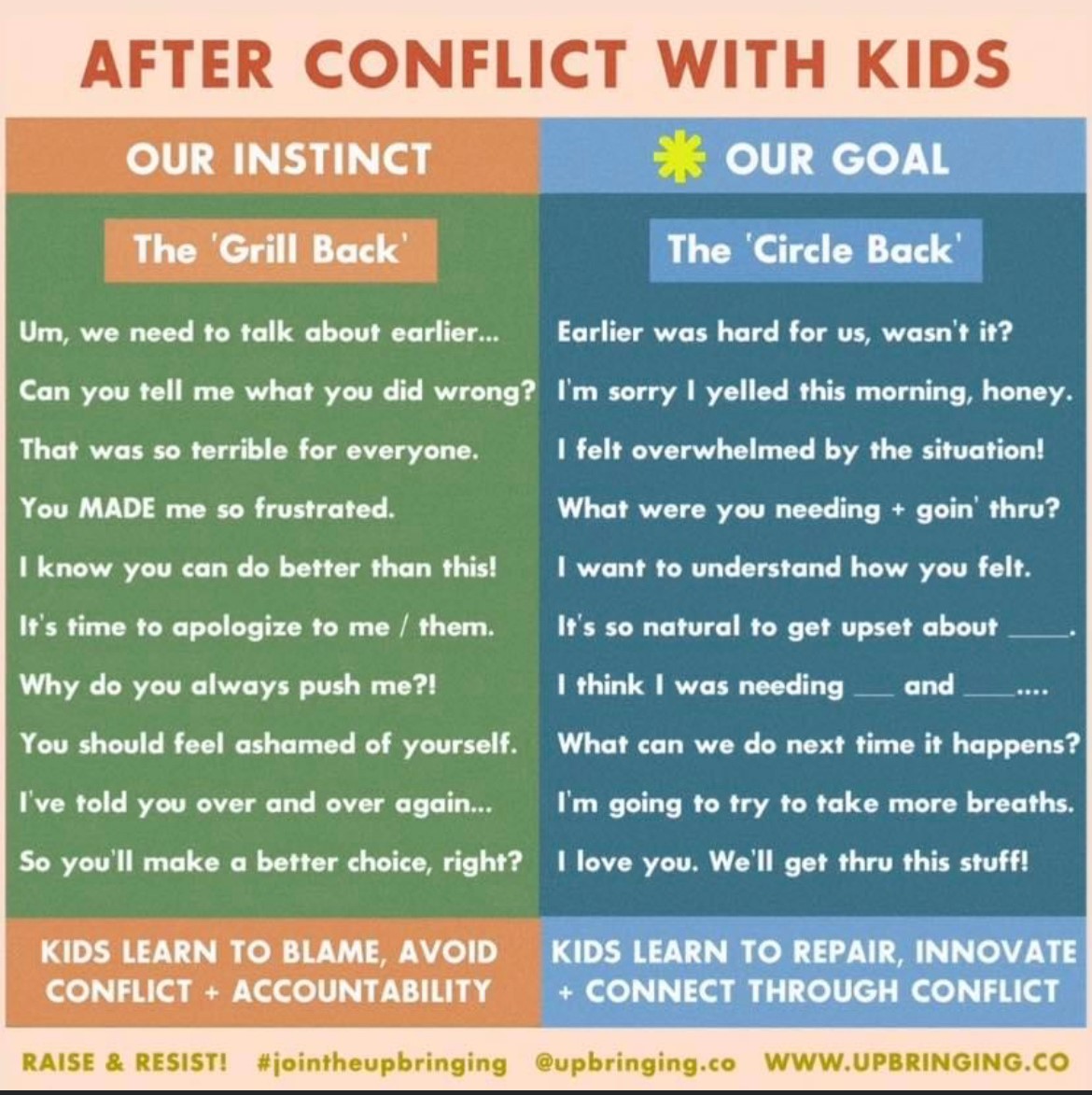
I found this graphic this week and thought it made a great follow up to last week.

Last week we talked about utilizing I Statements as a way to expressing feelings regarding a situation, without blaming others. 

When you read through The Grill Back you get blaming. 
When you read through The Circle Back you get accepting responsibility and working toward a resolution. 

As we work to be more mindful at school (and at home) it is good to take a few moments to reflect on how we are walking the mindful path.

Mindfulness teaches us to accept things as they are without judgement. That means accepting students and the fact that the may have behavior struggles. This does not mean accepting the behavior but rather accepting that they may happen. Then we can begin asking ourselves what message the student is conveying with the behavior, what needs they are seeking to have met, and how can you help them circle back.

Even reading the first line of each is a wake up call to how we address unwanted behaviors. Instead of saying "Um can we talk about earlier" just jump in and identify the challenge "Earlier was hard for us, wasn't it?" Let the student know the situation was hard on more then you and more then them. The second statement helps identify the feeling and who it affected (this is a nice little piece of a restorative conversation). 

When we begin to reframe from a feeling perspective we take ownership. This teaches our students how to take ownership too.

Owning feelings, especially the unpleasant ones is not easy for adults and we have a fully formed brain (if you are 25+ years old). We need to take intentional time to teach students this challenging skill.

Conflict resolution is a skill quickly being lost. With more and more students spending more and more time on screens they lose the interpersonal skills needed to work through a situation. For most of our students a resolution to conflict is to shut off a screen. What happens when its a person in front of you and not a screen? Our students struggle. Some adults do too.

Learning to talk with others helps us resolve not avoid conflict. Learning to address a situation from a feelings stand point helps with ownership instead of blaming.

Try some of the phrases from The Circle Back. Think of how you can reframe the way you address concerning behaviors and attitudes. 

How do you talk with your students regarding what you saw and what you want to see from them?

If you find you are using more statements from The Grill Back, follow the advice from The Circle Back and try and take more breaths.

Before you address a student do a quick self check and see if you can identify your feelings without judgment and if you can express them without blaming.

Take a breath together with the student. Lead by example. 

** Do Yourself a Favor and  Call the Number Below**

707-873-7862

It is a school project where kindergartners give you encouragement. It is the cutest. Enjoy!


Thursday, November 3, 2022

The Power of "I"

 Feelings happen. 

If you take some time to study the brain and it's behavior, then you will learn that we utilize our emotion center more often than we utilize our logic center.

Our Amygdala, which is part of what is known as our Reptilian Brain, is our emotion center. This is our center for Fight, Flight, Freeze, or Faint. This is part of our sympathetic nervous system. Our fear response. Our safety center. We need this, however, we do not want to simply run on this all of the time. When we run on this we create higher levels of cortisol in our body. Cortisol is our stress hormone. Too much can do significant harm to our body.

We need to learn how to slow down our thinking, switch off the Amygdala and turn on the Prefrontal Cortex. Our Prefrontal Cortex is our wise brain, our logic center.

How do we start this process? Where do we begin?

More often than not when feelings arise we blame others, express them in a big way, or do not address them at all.

We need to learn to identify and express them in a healthy way. We need to lead by example so our students begin to do that same.

If you have never tried to utilize an "I Statement" try it today.


Teaching and utilizing the "I Statement" takes a feeling from blaming to owning. We own the feeling we have and we assert it, not blame it on others. 

I feel frustrated when you choose not to listen to directions because it tells me that you are not focused or ready for the day. I'd like you to take some time to refocus and find a way to help yourself listen better. Maybe you could take a five minute break in the calm down corner.

I statements express a feeling about a situation. They do not shame or blame. 

it's not... 

Why is it you never listen to directions?
Are you even listening to me?
Is there a good reason you aren't listening?
You never listen!

Children (and adults) more often than not will stop listening when a statement is blaming. It is a comment reaction to become defensive, shut down, and not change the behavior.

An I Statement expresses how an action makes someone feel. The feeling belongs to the other person, you cannot tell them it is right or wrong. When you hear a feeling statement you listen from a perspective of understand not defense. 

A mindful way to address a concern is to utilize an I Statement.

I statements give the listener time to use the logic brain not the emotion brain.


Wednesday, October 26, 2022

Support v Enabling

                      How do you support your students? Are you really enabling?

At times it is difficult to tell whether or not we are supporting verses enabling our student's behaviors. As we explore the differences we can learn to build a supportive classroom and ensure we are not enabling negative behaviors.

The goal of support is to build resilience and develop coping strategies.  

Support should always empower a student to move forward toward greater stability and independence.

When we support a student we acknowledge difficulties yet not eliminate them. We should not be removing obstacles for children but rather teach them how to navigate and work through them.

Supporting a student means working with a child to overcome obstacles, manage fears, and build confidence for the future.

It is important to acknowledge feelings and validate them. This does not mean that we encourage the negative or allow them to be presented in a negative way. We can allow difficult emotions as long as we teach students to express them in a healthy way.

We can support students by providing clear, simple, and practical assistance. We can model healthy coping skills.

Ensure that you are providing structure that is appropriate for a child's age and ability. 

Remember to notice the small steps forward and praise the effort even if the outcome isn't to your desired goal yet. Keep coaching through the problems and help them get to where you want them to be.

While setting up structure ensure that you are not enabling negative behaviors by giving in to complaints or demands. It is easy to create peace in the short term but it will cause harm to your structure in the long term.

Address what is going on instead of allowing children to avoid uncomfortable situations. When we do not show them how to address a challenge we inadvertently teach them to cover up what they did or cover up what they forgot to do. Talk through the challenges and address them in real time.

Do not wait. Address things as they happen. Teach students to express feelings in a healthy way. Do not speak up for them when they have the ability to speak for themselves. Allow them the time and space to state and express their own feelings. This will help them take ownership and create a better understanding.

Remember: If you get upset WITH them instead of staying calm, YOU create emotional fireworks. Avoid the fireworks and stay calm. Show them how to be calm in difficult times and work through the feelings instead of exploding them.

Allow students to experience disappointment. Do not protect your students from natural consequences. They need to learn how to accept failure, disappointment, and the consequences for their actions. 

Tuesday, October 18, 2022

A Space for Calm

How well do you calm down when your emotions are running high?

Do you always take the time to process your emotions? If no, how well do you function if you allow the emotions to continue to control your mind and body?

As adult we do not always address our emotions in the healthiest way, if we address them at all. Adults often compartmentalize, hide, deny, or pretend their emotions are not overwhelming. Not all emotions are easily handled. 

When emotions become overwhelming our focus is diminished and so is learning.

If you haven't already, consider making a calming space for you class. 

Below is a link to a really great example of a calm down corner. This example would be best used for 3rd grade on up.

Calm Down Space

I really like the idea of the check in sheet. Have students sign in with name and time they use the space. This will help you keep track and notice patterns. You can use this data to talk with parents regarding; classroom behavior, self-regulation ability, and emotional needs. I also like the idea of taking time to explain how to use the space and then practicing the procedure. 

Think about how your class runs now. Do you have what we call "high flyers"? The students who are walking out, always wanting a break, or simply being disruptive? Perhaps they have some unchecked-in on emotions. Perhaps they brought home emotions to school and do not know how to separate home and school and they do not know how to process the feelings.

All classes can benefit from a calming and peaceful space. Below is another example of why and how to set up a structured space.

Peace Corner 

A peace corner should have a set of agreed upon limits. Five minutes is a great amount of time to get a student in a better spot. We have previously reviewed that chemically, our body only experience an emotion for about a minute and half. After that time it is our brain ruminating. Five minutes allows for feeling, processing, and calming. In the beginning a student may need a few more minutes until they begin to learn self-regulation and the ability to utilize the needed materials or manipulatives to help with a specific emotion.

When you set up and explain your calming space don't be afraid to share about the brain, the science, and the why behind the space. Normalize the need and encourage students to give each other understanding and privacy. Talk about not watching students. Talk about not asking why the space was used. Encourage the understanding that we all need to process emotions in a healthy way.

Set limitations and post them. Make it known that it is one person at a time, to help with challenging and distracting feelings. Ensure the students know that the space is not an escape from learning and should not be used to play or sleep.

The time you give to explaining and demonstrating the use of the calm space will be given back to you the more students learn to utilize the space and calm their emotions.  

If you need help setting up a space please reach out. I have resources and can help you take time to explain the space to your students.


Tuesday, October 11, 2022

Mindful Inclusion to Reduce Bullying

 Mindfulness creates an Inclusive Culture where everyone can say " I Count".

October is Bullying Awareness and Prevention Month. 

As a school we need to do more than be anti-bullying, we need to take meaningful action to empower victims, heal bullies, and create an inclusive culture.

Studies have shown that schools with only an anti-bullying program do not have a reduction in bullying, but rather see the same level or an increase. Anti-bullying program can inadvertently teach bullies new ways to hide behavior, provide new ideas for behavior, and empower them to continue. Anti-bullying programs also keep the victim as a victim and do not empower them, leaving them vulnerable to more incidents of bullying.

Schools need to do more. They need to get to the root of the problem. Culture. Values. Expectations. 

Mindfulness is a great way to create a positive and inclusive culture. Mindfulness will empower the victim and help encourage the bully to become a better person.

Bullies often have low self-esteem and are bullied themselves. Bullies also often display a lack of impulse control. Mindfulness has been shown to improve mental health, reduce anxiety, increase self-esteem, and help promote impulse control.

Mindfulness could be the key (or a key) to reducing and ending bullying in schools. 

Mindfulness empowers victims allowing them to understand that bullying while targeted at them is not about them. Understanding this helps them to reduce reactivity to the bullying events. When reactions are diminished bullies are more likely to reduce and give up behavior. When a bully does not see the response they are looking for they move on or give up all together. 

In 2014, three years after Inner Explorer was launched a study showed that those who implemented the program at their school saw a 50% reduction in reactive behaviors of children. Mindfulness programs, such as Inner Explorer, help teach students to think through their actions before taking action.

In 2015 the National Education Association shared that 1 in 3 students report being bullied and 7 in 10 report they are cyber bullied. (This are pre-pandemic numbers, with the pandemic cyberbullying has seen an increase). It was also reported that 50% of the bullying stops when peers intervene. 

The need to empower and equip our students with the ability and bravery to stand up and stop bullying is great. Mindfulness helps bring awareness to the "here" and the "now" which helps students stop and think about their actions. Mindfulness increases focus, attention, and calm. These are tools to help the bully and the bullied reduce negative behaviors and empower standing up for what is right.

Janice Houlihan, co-founder of Inner Explorer and an author has been quoted saying, "Mindfulness practices help the bully, victim, and any witness involved develop a deeper awareness of themselves, resilience, compassion, and a greater ability to regulate their emotional responses."  

Take some time this week and all through the month of October to begin (or continue) a mindfulness practice in your class. Ten minutes of mindfulness a day can reduce reactivity and increase empathy. 10 minutes of mindfulness a day can help improve behavior, self-esteem, and students grades.

Try Inner Explorer today. Connect with me if you need assistance. Let's work together to get to the root of bullying and create a school where ever student and adult can say "I Count".


Tuesday, October 4, 2022

The Sounds of Mindfulness

Simon and Garfunkel once sang to us about The Sound of Silence. In this song they stated "no one dared disturb the sound of silence." Can you say the same for your class?

Mindful listening can help us with mindful silence. It isn't simply to gain a calm and quiet class for the mere sake of quiet, but for the science behind why we need peace and calm in learning.

Over the years, dating as far back as 1972 , studies have explored the idea that sound has an effect on learning, memory, and cognition. 

Some of the original studies focused on children who lived near airports and children who were living on the main floor of apartment buildings. These studies found that the increase in sound, decreased reading skills and comprehension at school. With theses studies as the foundation more studies were conducted with similar results.

A 2006 study focusing on 3rd grade students found that when there was babble present in the learning environment students test scores decreased. 

In 2010 a study of 1st graders found that both verbal and non-verbal (ex: talking and slamming doors) had a negative impact on memory of material.

Children are less able to separate and ignore irrelevant sounds and are more susceptible to sound-induced disruptions. 

These studies have also found that children with attention concerns, such as ADHD and children who are non-native speakers, such as ELL, are even more at risk for educational deficits due to sound disruption. 

Is the volume in your class inhibiting learning and memory? Would you like to see higher test scores and better readers?

Have you taken time to include mindfulness in your day? Have you found a mindful way to reduce the sound without sound?

Shouting for your students to be quiet is not working. 


Mindfulness encourages us to take a moment and become silent. To slow down and observe. How can you utilize mindfulness to calm the babbles, the chatter, and the non-verbal sounds that disrupt learning?

Try a sound mindfulness practice. Studies show that nature sounds are calming, white noise is calming, and soothing music is calming.

Take your students on a mindful sound walk. Have them explore the school and investigate the sounds around them. Take a mindful sound walk for yourself. Explore the halls and listen to classes. Are there any in which you would thrive? The sounds studies show that while children are more greatly affected, sound does have a negative impact on adults as well. Are there any rooms in the school which might promote learning and increase attention? What can you learn from your mindful sound walk?

Using mindfulness and specifically sound mindfulness can be a good way to help students learn to focus attention. 

Some small studies with adults have also taught us that adults are easily distracted by simple sounds such as a ping of text message. Participants in a study of sound found that if they heard a text message ping during a message they enjoyed the experience less. Even as adults sounds can turn us from calm and joyful to irritated and unfocused. 

Try utilizing the sound practices on Inner Explorer. These are 1-2 minutes of sounds to help calm and focus the mind.


Friday, September 30, 2022

Embracing Autumn with Mindfulness

 How do you see autumn?

An article from the New York times shared that the poet Percy Bysshe Shelly once compared the falling leaves of autumn to decaying corpses in the grave. 

How do you see about the season?

In some recent small studies it has been found that those who tend to ruminate or are more easily preoccupied with thoughts in the autumn season also are more likely to be affected by season depression in the winter (SAD).

The studies also found that unlike the "spring forward" time change, the "fall back" negatively impacts mental health. More depressive episodes occur around the autumn time change than the spring time change.

Autumn is a time of change. The sunlight is becoming less. The temperature is dropping. Leaves and plants are dying. Many people begin to reflect on nature's change and relate it to their own lives. 

Autumn becomes a time of discomfort with change. A mourning period for the lost summer sun and days at the beach.

Autumn does not have to be "Death's second self" as William Shakespeare once said. This season is a perfect time to build a mindfulness routine. Dr. Wilson of the University of Mississippi has called fall the prefect time to "harvest" the good from the summer and be present and enjoy the fall.

We can use fall as a season to build resilience. 

Resilience is ones capacity to adapt to challenging life experiences. 

Dr. Kecmanovic the founder of Arlington/DC Behavior Therapy Institute, shares that autumn is a time to work on acceptance of uncertainty. Accepting uncertainty is a great way to build resilience.

In some recent studies it has been found that the "intolerance of uncertainty" is associated with poor mental health.

While we are all faced with uncertainty at times we do not have to be intolerant. We can use mindfulness to learn to lean in and cultivate rather than run from the uncertainty. 

Dr. Kecmanovic encourages us to put aside what makes us comfortable and in control and face uncertainty, lean in, build resilience. 

A great mindfulness practice for fall is, Step Back-Observe. 

 Instead of seeing autumn through the eyes of the poet Shelly or the playwriter Shakespeare, Step Back-Observe and embrace and enjoy.

See the leaves not as merely dying, but as going thought a beautiful transformation in their lives. Take time to sit out in the crisp fall air and observe the changing colors. Notice the sounds of fall. Be with nature not separate from nature. 

We all have a life cycle. Embrace each moment of the cycle without focusing on the end. Mindfulness teaches us to be present in the moment, on purpose, without judgement. This is a perfect way to embrace autumn. In the moment, on purpose, without judgement. 

Embrace the season to help support positive mental health.


NY Times Article https://www.nytimes.com/2022/09/21/well/live/fall-autumn-mindfulness.html